

An independent study commissioned by the City of Seattle says the city’s tax structure is unique among its peers in the way it “specifically penalizes the hiring of senior, high-compensation workers,” with that penalty falling overwhelmingly on large tech employers.
Overall, Seattle’s business taxes are actually in line with competing cities, write researchers from the economic consulting firm Formation in the new report. But Seattle’s taxes are “particularly distortionary when it comes to hiring high-wage employees,” they add.
Mayor Katie Wilson helped design the tax, known as JumpStart, before taking office. But even the strongest supporters of new local and state taxes would concede that Seattle is “reaching the limits of how much it can tax the industries and people that it is depending upon to drive its growth,” the researchers write.
Another risk for the city is the resulting concentration of the tax base. Three-quarters of the payroll tax on large employers comes from 10 companies. Nine of them are in tech-related sectors.
A big company shifting 10,000 workers out of Seattle would cost the city about $50 million a year in payroll tax revenue, the researchers say in an accompanying slide deck, without naming Amazon explicitly. That’s more than a quarter of the $175 million deficit the city projects for next year.
@media (max-width: 600px) {
aside.callout { float:none !important; max-width:100% !important; margin-left:0 !important; margin-right:0 !important; }
aside.callout .callout-img { display:none !important; }
}
In that way, much of the city’s financial future depends “on the marginal location and compensation decisions of a handful of employers,” the report says. Because much of the taxed compensation is vesting stock, it adds, the city’s revenue is exposed to “the single most volatile attribute of these firms — one the city has no ability to forecast or influence.”
Reducing that dependence through growth is the bigger point of the report.
The 127-page assessment, called “Seawall: Building a Resilient Seattle Economy,” goes well beyond the topic of taxes. The title refers to Seattle’s rebuilt waterfront seawall, engineered to hold back the water and also let marine life take hold. The researchers offer this as a model for protecting the city’s economic base while building a more diverse economy on top of it.
A decade of growth lifted wages at every level of the income spectrum, the report finds. Few other U.S. regions spread prosperity as broadly. But the same growth made Seattle far more expensive, especially for families.
Fast-forward to today, and the report sees an economy that’s dangerously concentrated, “significantly more AI-exposed than the national average,” short of the electricity it will need, and no longer producing mid-sized companies.
In danger, not in decline: The report is also careful to point out the city’s unique position and strengths. Seattle’s tech workforce is “almost peerless,” it says: 23% of the nation’s AI engineers are based in the region, and output per tech worker is more than double the national average.
The region also has the rare combination of a big tech industry and a strong manufacturing base.
Seattle “may not be in decline, but it is in danger,” the researchers write — “not because it is losing its place in the industry, but because the industry could undergo a radical change, and arguably already is.”
The concern that Seattle is becoming “the next Cleveland,” raised in a GeekWire column in February by Seattle tech veteran and angel investor Charles Fitzgerald, is “likely hyperbolic,” the researchers write. (They acknowledge that it “caused quite the stir this past winter.”)
The report points instead to Portland and Los Angeles as the more relevant warnings, citing Portland’s pileup of new business taxes and Los Angeles’ failure to turn a deep talent pool into jobs.
Fitzgerald responded Wednesday evening on his blog, Platformonomics, writing that the city “has finally acknowledged there is such a thing as an economy.” His main objection was who wasn’t in the room: “No businesses were involved, but that seems to be the norm hereabouts on economic matters.”
The report’s acknowledgments list dozens of interviewees, including the Seattle Metropolitan Chamber of Commerce, the Washington Roundtable and the Tech Alliance. No large tech employer is among them.
Ryan Donahue, a co-founder and managing partner at Formation, said in an email that the researchers interviewed many business representatives but no large companies directly, saying he expected a predictable message from their government affairs teams.
The person who led the report’s tax and cost analysis previously ran Amazon HQ2 recruitment at the Virginia Economic Development Partnership, the agency that landed the project for Arlington, Va., Donahue said, providing insights into how firms like Amazon weigh those decisions.
A path forward: The report recommends that the city focus on five industries: artificial intelligence, cleantech, maritime, life sciences and space. Cleantech is the priority, the report says, because Seattle owns or regulates much of what the sector needs, from Seattle City Light to building codes, permitting and land use.
The Seattle Office of Economic Development commissioned the report from Formation in 2025, under then-Mayor Bruce Harrell, to examine the drivers of the city’s business climate.
Harrell’s successor, Mayor Wilson, released the report Wednesday afternoon alongside an executive order convening a task force of business, labor, community and civic leaders, directing the city to improve permitting pathways, and calling for a proposal to create a Seattle Strategic Initiatives Fund.
In releasing the report, Wilson’s office said the findings “are independent and are not City policy.” But speaking on KUOW-FM’s Soundside as the report was released, the mayor called it “fantastic,” describing it as “super nuanced,” and urging listeners to take the time to read it.
The cost of a hire: JumpStart, the payroll expense tax, applies to large employers based on the compensation they pay to high-earning workers in Seattle. Approved by the City Council in 2020 and in effect since 2021, it was created to fund affordable housing, small-business support and climate programs, but the city has increasingly used it for general government operations.
Wilson helped create the tax before running for mayor, saying on her campaign website that she “played an instrumental role in designing and passing” the payroll tax.
Under JumpStart, hiring a software engineer at $650,000 in total compensation costs about $17,000 a year more in Seattle than in Bellevue, the report says. For an employee earning more than $1 million, the difference exceeds $33,000. San Francisco imposes no per-employee tax at all, and New York City’s equivalent is less than $6,000, according to the researchers.
That $17,000 reflects the tax’s top rate, which this year applies only to employers with about $1.3 billion or more in Seattle payroll. Two or three companies at most are in that tier, the report says. At the city’s lowest rate for that pay level, the same engineer would cost about $11,800, according to Seattle’s published rates.
The rate rises with an employee’s pay, and a company that crosses one of the city’s payroll thresholds pays the higher rate on every qualifying worker, not just the next hire.
“No other comparison city has a tax with both of these features,” the report says.
An issue of perception: Business leaders interviewed for the study described JumpStart as a problem “not primarily for its cost but because the process of enacting it communicated that the city’s governing orientation is fundamentally extractive.”
The researchers add: “Whether or not that characterization is fair, it is the operating perception, and perception shapes location decisions.”
But the researchers stop short of recommending a change. Taxes have “modest effects on firm location and expansion decisions,” they write, and Seattle is unlikely to lose its biggest employers to other regions, because the alternatives are either more expensive or have weaker talent.
“The Eastside is the only real threat in that regard,” the report says.
The study is blunt about what is at stake in keeping those employers. “If they leave,” it says, “Seattle won’t become more equal, it will just become poorer.”
What to do about taxes? The report does not recommend raising or lowering that top rate. Research on how firms respond to local taxes draws on thousands of firms across dozens of jurisdictions, it says, and “cannot tell us how any one firm will respond to any one tax change.”
With two or three firms in the top tier and “one firm by far the most dominant,” the question “is fundamentally a question about how that single firm will react.” It adds, “That is not a question this report, or the literature it draws on, is equipped to answer.”
GeekWire has contacted Amazon for comment on the report.
Other tax options that have been floated — vacancy taxes, wealth taxes, head taxes beyond JumpStart, expanded gross receipts schemes — are “either disallowed under state law or would, if enacted, likely push out the firms and workers Seattle most needs to retain,” the report says.
And once the state’s new 9.9% tax on income above $1 million takes effect in 2028, Seattle earners above that level will face a combined state and local marginal rate of about 10.5%. Pushing meaningfully above that, the report says, “would be a high-stakes tax experiment.”
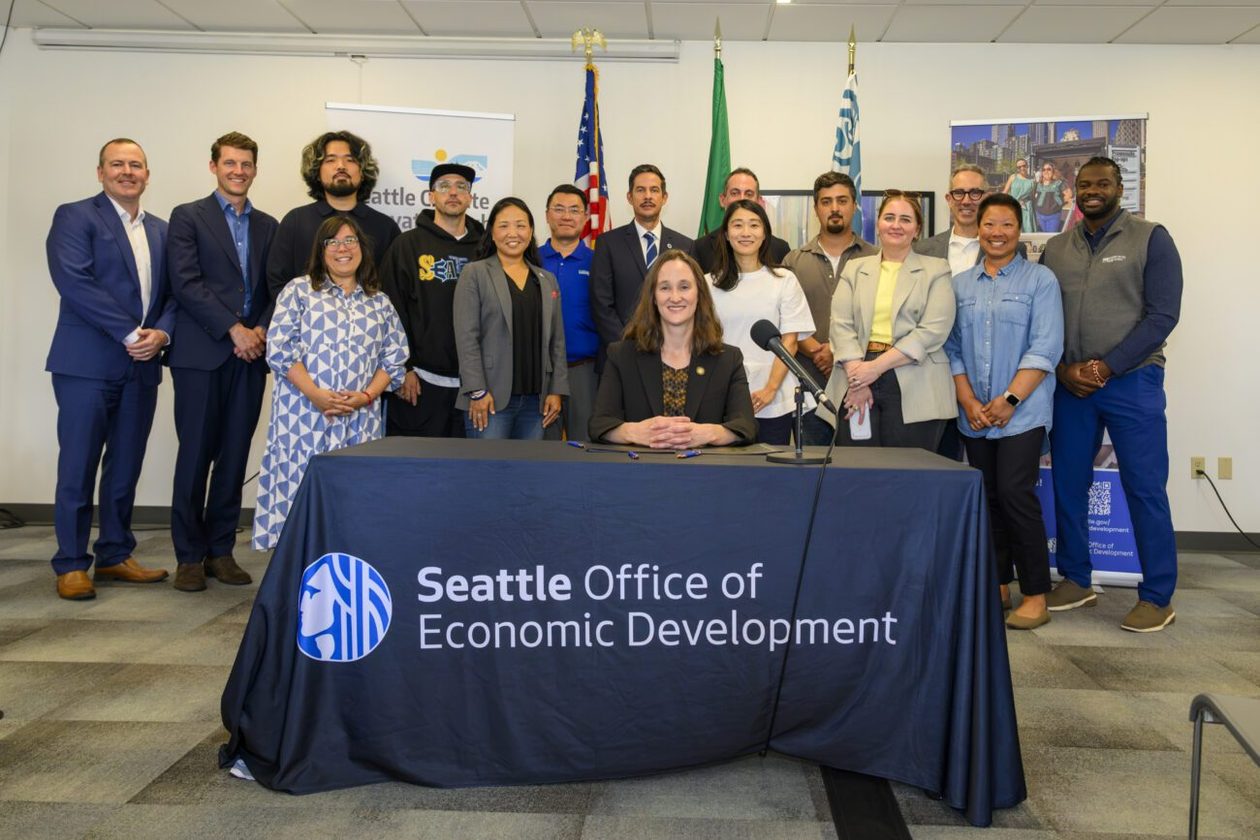
Where Wilson stands: The mayor has already conceded the Bellevue point. “I don’t think it’s good that it is less expensive to do business in Bellevue than in Seattle,” she said in May. “We’re going to be taking that into consideration.”
She defended the tax in June, crediting it with helping Seattle recover from the pandemic and cautioning against blaming downtown’s problems on any single cause.
Her relationship with the tech community has been rockier. At a Seattle University event in April, asked about that state tax, Wilson said concerns about wealthy residents leaving were “super overblown” — then waved and said, “the ones that leave, like, bye.” The moment drew national coverage and criticism from Seattle investors.
A bet on cleantech: Taking a step back, the report says Seattle’s best opportunity is in cleantech, a category it defines broadly to include clean energy generation, energy efficiency and sustainable production methods and materials.
The shift is already showing up in local venture funding. Cleantech and energy companies took 3% of the venture capital raised by Seattle-area private companies from 2016 to 2020, and 20% from 2021 to 2025, according to Crunchbase data cited in the report. Three companies — TerraPower, Helion and Group14 — account for 70% of that.
The city “should be most concerned about AI but most active in cleantech,” the report says.
AI will ultimately be more important to Seattle’s future, the researchers explain, but the city has almost no ability to shape it. Cleantech is different: Seattle owns the electric utility, writes the building codes and controls permitting and much of the land.
The city can also use its own purchasing power to create a market for what these companies build, the report says, pointing to a New York program that used public housing demand to bring a new cold-climate heat pump into production.
To reach the top tier of cleantech ecosystems, the report says, Seattle would need a dedicated entity putting at least $5 million a year into growing the sector, funded through ratepayer charges, philanthropy, corporate sponsorship and competitive federal grants.
What’s next: According to the city, Wilson’s executive order calls for the task force to convene industry roundtables in the coming months. The report’s own first-year list runs to ten items, including a business-led commission on the city’s fiscal exposure, with an emphasis on AI, and structured visits with 50 companies across the five industries it identifies.
Others include naming a senior staffer in the mayor’s office to run the city’s AI agenda, and a childcare cost-sharing pilot split three ways between employee, employer and city, with the city’s share paid out of JumpStart.
On taxes, the report’s primary recommendation looks beyond City Hall. It urges Wilson to build a cross-partisan coalition of mayors and county executives to press Olympia for new municipal revenue tools, including changes to the state’s 1% cap on property tax growth.
A caller on KUOW asked Wilson whether there’s a limit to how much Seattle should grow. She said she shares the concern, then pointed back to the report, which she said makes clear there is “no graceful path” for Seattle to cool down its growth.
“We can’t go back to the ’90s,” she said.
Fonte ==> GeekWire